Saturday, May 30, 2015

Show 131: Swinging Bach, and The Entertainer

[Added on 2015/7/18:  This used to be called Show 27.  I've renumbered the shows, so that this one is Show127.  The first digit will indicate which series the show is from: 1 for the first cycle, 2 for this second cycle, and so on.  For instance, the July 4th show for this year will be numbered numbered Show201, and so on.  If you didn't figure this out yet, my first show aired the week of July 4th, 2014.]

You'd think, because the school year is over (for our school, anyway), that I would produce better crafted shows, but no; they're even more arbitrarily slapped together than ever.

This show was initially inspired by Scott Joplin's The Entertainer which was being broadcast from a passing ice cream truck, and I got to thinking that it might be fun to make a MIDI file out of it, by ear, and feature that on the show.  Then, I got to thinking, it might be nice to show how I go about doing it, in stages.  (It's still by ear, mind you; I did not go to the written score, as I do with Bach, for instance.)

Once I got started, I ran out of material pretty soon, but I stumbled on the DVD of Swinging Bach, from 2000, centered around Bobby McFerrin.  Now, the WXPI agreement with ASCAP and the, er, corresponding institution in the UK permit us to play any music from any recorded source, for non-profit purposes.  So I went about trying to acquire the soundtrack of the movie, but I failed.  But I acquired the video of it, and extracted the sound from that instead.  That provided about another half hour.

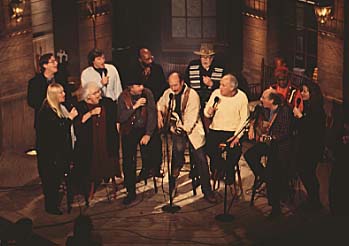
Then Uma, a close friend, posted a page that linked to several tracks of the music of the band she plays with, Minstrel's Ghost.  That was the last track for the night.

So there's really no rhyme or reason for the compilation for tonight; it's a bunch of music that hit my radar over the week, filled up with recordings from my collection, to balance classical, popular, folk, humor, and curiosities.

Unfortunately, my plan of making each show balanced with all these elements has resulted in less of an overall theme for each show.  Now, it is possible impose an overall structure for each show even while maintaining the four or five departments of classical, folk, popular, humor and curiosities.  For instance, for the week of July Fourth, you can easily imagine a program that concentrates on nationalistic music in each of those categories.  (I try to imagine that I live in a post-adolescent USA, in which the common man is comfortable with hearing music of foreign lands even during Independence Week.  In some parts of the country, people listen to nothing but the Star Spangled Banner all year long.  These are the places where people don't pay taxes.  Did you get the irony there?)

But I get into an "Off Duty" sort of mood over the summer, and it feels like a lot of work to put together a show that has structure in the rows as well as the columns.  Still, I think I will do a careful job for July Fourth, the first week of July; in fact, if I repeat last year's show, it already has all these elements.

Part A
Part B
Part C
Part D

Archie

Saturday, May 16, 2015

Show 130: Glorious Medley

[Added on 2015/7/18:  This used to be called Show 30.  I've renumbered the shows, so that this one is Show130.  The first digit will indicate which series the show is from: 1 for the first cycle, 2 for this second cycle, and so on.  For instance, the July 4th show for this year will be numbered numbered Show201, and so on.  If you didn't figure this out yet, my first show aired the week of July 4th, 2014.]
 
I spent most of last week away from my music collection, so I had to fall back on whatever I had on my so-called hard drive.  I'm putting up the playlist, for the simple reason that there really is no pattern, (there seldom is, is there?) and if you want to hear any of these, you would have to listen for it until it shows up.  I hope they get played in this order:

Part A

Bach:  Herz und Mund und Tat und Leben, Chorus from BWV 147
This is the opening chorus (once again) from the Cantata from which the most popular "Jesu, Joy of man's desiring" chorale is taken.

Chanticleer: An American Folk Medley
Includes O sinner man, and several others.

Mozart: from Die Zauberflöte (The Magic Flute), The birdman's song (Ein Vogelfänger ich bin, ja)

Johann Strauss, Jr: Trisch-Trasch Polka (King's Singers)

Philip Glass: Closing, from Dance Suite

Peter, Paul and Mary: I Dig Rock and Roll Music

Part B

Johannes Brahms: Academic Festival Overture, Op 80
 

George Frederick Handel: Alla Hornpipe from The Watermusic
 

J. S. Bach:  Air, from Suite 3 in D major for Orchestra (Classical Music String Quartet)

J. S. Bach: Brandenburg Concerto No 1 in F Major - Adagio


Franz Josef Haydn: Trumpet Concerto in E-flat major I Allegro (Rolf Smedvig)
This is in memory of Rolf Smedvig, who was a founder member of the Empire Brass Quintet, and was the music director of the Williamsport Symphony in the mid 80's.  He passed away last week.

Part C

Frederik Chopin: Etude No 10 In A Flat Major from Op 10
This is new to me, but is certainly lovely.

George Gershwin: Rhapsody in Blue (Original Jazz Band Version) (Joanna McGregor)
The version heard most commonly today is a symphonic version; apparently this is the original composition, written for piano and a jazz band.

Leonard Bernstein: Overture to Candide

Brahms: Hungarian Dance No 5 in G minor

Part D

Pietro Mascagni:  Ave Maria from Cavalleria Rusticana (Angela Gheorghiu)


Stephen Foster:  I Dream of Jeannie With the Light Brown Hair (John McCormack)
 

Ludvig van Beethoven:  Symphony No 5 In C Minor, Op 67, movements 3 and 4
Apologies: these were horribly distorted on the broadcast.  They are repaired here!]

[Bonus track:] Archie's Mystery Tune, in Waltz Time

Archie

Friday, May 15, 2015

Show 129: A restructured Archie's Archives, and lots of repeats

[Added on 2015/7/18:  This used to be called Show 29.  I've renumbered the shows, so that this one is Show129.  The first digit will indicate which series the show is from: 1 for the first cycle, 2 for this second cycle, and so on.  For instance, the July 4th show for this year will be numbered numbered Show201, and so on.  If you didn't figure this out yet, my first show aired the week of July 4th, 2014.]

In this episode I make the changes I have been planning for a while: to focus on
Part A: Classics for the first half hour,
Part B: World music and Folk music for the next half hour,
Part C. Pop music for the third half hour,
Part D: Comedy and curiosities for the last half hour.

Already, last week, I discovered that this would not work.  Still, this is roughly how this program, this week, was structured, so I leave it at that.  (Next Saturday, it will be a completely unstructured show, probably played at random by SAM, the studio computer.)

The playlist for last Saturday, May 9th, was as follows:
  • Mozart: Piano Concerto No 24 in C minor K 491.  This was almost completely chopped out by the station computer program.  Sorry about that.
  • Bach: Brandenburg Concerto No 5 in D Major
     
  • Bach: Contrapunctus I from The Art of the Fugue
     
  • Ravel: Le Tombeau de Couperin- No 3, Forlane
     
  • Mary Hopkin: Blodwyn Gwyn
     
  • Anonymous: Bransle de la Torche
     
  • Anonymous: Waly, waly (Choir of New College, Oxford)
     
  • John Dowland: Mr Giles Hobies Galiard (The King's Noyse) 
  • Vienna Boys Choir
    • Trisch-trasch Polka
    • Mozart:  trio from Magic Flute
    • Innsbruck, ich muss' dich lassen
  • Paul Mc Cartney, Michael Jackson: The Girl Is Mine
     
  • The Beatles: Every little thing
     
  • America: You Can Do Magic
     
  • Renaissance: Black Flame
     
  • Dowdon, Besly: The Second Minuet (sung by Webster Booth and Ann Ziegler)
     
  • Jimmy Fallon-Jack Black-Extreme Side by Side Comparison of More Than Words
     
  • Billy J. Kramer and the Dakotas: Little Children
     
  • The Beatles: I'll follow the Sun
     
  • Harry Belafonte: Man Smart, Woman Smarter
     
  • George Harrison: My Sweet Lord
     
  • St. George and the Dragonet (Stan Freberg)
     
  • Edward Elgar: Pomp and Circumstance march no 1

Thursday, April 23, 2015

Show 128: Close Harmony and Barbershop

[Added on 2015/7/18:  This used to be called Show 28.  I've renumbered the shows, so that this one is Show128.  For instance, the July 4th show for this year will be numbered numbered Show201, and so on.  If you didn't figure this out yet, my first show aired the week of July 4th, 2014.]
 
Well, something went slightly wrong with last Saturday's broadcast; the programming computer was cutting songs off before they were completed, so that the program ended several minutes too early.  Anyway, here is the podcast.

Part A

Ever since my father brought home an LP of the Yale Whiffenpoofs (the glee club) in 1964, I was hooked.  I was surprised and delighted to learn that my eldest stepdaughter had belonged to a girl barbershop quartet in high school, and saw several videos of them performing at the State Fair in Bloomsburg.

Close Harmony and Barbershop are not exactly the same thing, but I'm going to include both kinds, even a little classical music.  The groups being featured are the Yale Whiffenpoofs of 1973, Chanticleer, a group from the San Francisco area; the King’s Singers, alumni of the world-famous choir of King’s College, Cambridge; Manhattan Transfer; The Chordettes, a female group from the fifties, and The Quintones, from even earlier, and a couple of others.

At the moment, the selections by the King’s Singers are a little on the esoteric side, consisting of madrigals, both English and French and Italian, and one in German.  The playlist is as follows (with possibly some changes in sequence):

Puttin on the Ritz
Mr Sandman:  Roberto Rico and his band.

Sweet and Low:  The Chordettes

Amor vittorioso, balletto for 5 voices: King's Singers

Mozart:  Piano Concerto No 21 (Elvira Madigan) -- iii-Allegro vivace assai

When My Sugar Walks Down The Street:  The Quintones


Brigg Fair: Chanticleer (Wondrous Love)

Part B

Popurri los Trios: Sin Ti, Solamente Una Vez, Sabor a Mi, Quisas Quisas,  by Mariachi Sol De Mexico (La Nueva Era)

The Times They Are A Changing: Peter, Paul & Mary (Lifelines)

El Manisero: Chanticleer (Wondrous Love)

Stewball: Peter, Paul & Mary (Lifelines)

Of All the Birds That I Do Know
The Silver Swanne, madrigal for 5 voices: The King’s Singers (Madrigal History Tour)

Loch Lomond:  Chanticleer (Wondrous Love)

Aphrodite: Whiffenpoofs of 1973 (Sunshine Girl)

La, la, la, je ne l'ose dire: The King’s Singers (Madrigal History Tour)

Sunshine Girl: Whiffenpoofs of 1973 (Sunshine Girl)
Il est bel et bon, commere, mon mary (Chansons musicales, Paris 1534)
The King’s Singers (Madrigal History Tour)

Whiffenpoof Song: Whiffenpoofs of 1973 (Sunshine Girl)

L' Amour de Moy: Chanticleer (Wondrous Love)

We Three: Chordettes (Close Harmony)


Lirum bililirum (Un sonar de piva in fachinesco), madrigal
The King’s Singers (Madrigal History Tour)
Java Jive
Whiffenpoofs of 1973 (Sunshine Girl)
Il bianco e dolce cigno, madrigal for 4 voices, S 2
The King’s Singers (Madrigal History Tour)
La Villanella
Chanticleer (Wondrous Love)
Tantzen und springen
The King’s Singers (Madrigal History Tour)
Un Gentil Amoureux
The King’s Singers (Madrigal History Tour)
Cucu, cucu, cucucu, cancionero (from Cancionero de Palacio)
The King’s Singers (Madrigal History Tour)
Babylon / Oh, Sinner Man
Peter, Paul & Mary (Lifelines)
Nelly Bly
Chanticleer (Wondrous Love)
Oy, Polná, Polná  Korobushka
Chanticleer (Wondrous Love)
Delia
Whiffenpoofs of 1973 (Sunshine Girl)
Vitrum Nostrum Gloriosum
The King’s Singers (Madrigal History Tour)
Glorious Apollo
Harvard and Michigan Glee Clubs
Leroy Anderson Potpourri
Lycoming College Band (Spring Concert 2015)
Wolfgang Amadeus Mozart Die Zauberflöte  /  Divertimento, O Isis
Bernd Hassel, Juergen Gode, Stefan Zimmer (Music for 2 Clarinets and Bassoon.)
Faure: Cantique de Jean Racine
Lycoming College Choir, Lycoming Community Orchestra
Mozart: Piano Concerto 21
Annie Fischer, Philharmonia Orchestra

Sunday, April 19, 2015

My Apologies!

Last Saturday's issue was meant to be a repeat, but the one that was aired was not the one intended!

I thought I had placed a much older show ready to go on the program queue, but it repeated the show from just one week ago instead!  I guess this means I have to get a whole new one ready for next week.  Anyhoo, on the bright side, the show that aired was this one, from April 11.  I don't have to put up a new podcast!!

I'm trying to put together a new program that highlights close harmony.  I have a feeling that I might not be able to find too many different recordings, or at least a good variety.  But that's the plan.

Arch

Sunday, April 12, 2015

Show 127: Folk Music, Traditional Music, World Music, and Folk

[Added on 2015/7/18:  This used to be called Show 27.  I've renumbered the shows, so that this one is Show127.  The first digit will indicate which series the show is from: 1 for the first cycle, 2 for this second cycle, and so on.  For instance, the July 4th show for this year will be numbered numbered Show201, and so on.  If you didn't figure this out yet, my first show aired the week of July 4th, 2014.]
 
Notice the distinction between Folk Music, and Folk.  Folk Music is music passed on by the oral tradition, Folk is music written in a certain style (e.g. Woody Guthrie, Pete Seeger, John Denver, Gordon Lightfoot).  Traditional music is a little more vague: it is music written in the last couple of decades, embodying national or regional aspiration, and widely adopted as music of the people, but not pop music, e.g. "Drink to me only" by Ben Jonson, "Loch Lomond" by Robert Burns, and "Swanee River" by Stephen Foster.

Part A

Introduction--Bach: Organ Fugue in C major, BWV 545, with rhythm track
When I first signed up to do a show on WXPI, they interviewed me and asked me to describe what sort of show it would be.  So I said, it’s going to be all classical music, with lots of peripheral information so that people wanting to get a handle on it could do that.  I was asked whether there would be World Music, and I said, well, maybe a little of that.  But it was soon clear that a lot of the so-called Core Group (which is a sort of informal committee that meets every week) was really interested in World Music.
So this week, I’m going to do my bit for World Music.  I’m going to play a lot of classics as well, because I don’t want to use up my entire folk music collection.
Again this week, we have a different fugue for our theme music, but we will go back to the old tune next week!

The opening scene of Figaro, from another production
Mozart: Duettino 1 from The Marriage of Figaro--Figaro and Susanna
Now, you know Mozart’s mother tongue was German, which is what is spoken in Austria.  So, though he wrote his best-known work, which is The Marriage of Figaro, to be sung Italian (it was a play by a Frenchman, of a story set in Spain, written by an Austrian, to be sung in Italian.  How about that?), anyway, German speakers swear that the translation of the libretto into German is funnier and better than the original Italian libretto.  So here’s the opening scene with Susanna and Figaro, sung n German, where Figaro is measuring the bedroom for a new bed, for after they’re married.  Their new bedroom is conveniently near the suite of the Count and the Countess.  Figaro is being sung by a well-loved German bass, Walter Berry.

Mozart: Recitative and Duettino 2 from The Marriage of Figaro--Figaro and Susanna
In these two cuts, Susanna explains to Figaro just why being so close to the bedroom of the Count is a problem.  He could send you on an errand, she says, and when you're gone, the Count might get a headache, or something, and might need a massage from me, you know?  The whole opera is about this problem: that the Count has his eye on Susanna.

Muththuswamy Dikshitar: Vaathaapi Ganapathy
To start our World Music features, I’m going to play a hymn to Lord Ganapathy.  Ganapathy is the Hindu God represented by a being with an elephant’s trunk, a child of the god Shiva, and a secondary deity in the Hindu pantheon.  The song was composed by Muththuswami Dikshitar, who holds a place similar to Bach among Karnatic composers, so is greatly venerated.  The vocalist is M. S. Subbulakshmi, one of the greatest female South Indian classical vocalists, who was invited to sing at the United Nations, and was introduced by U Thant.
The words are in Sanskrit, and I can only recognize the words Varanasya, which is Benares, and Swayamvaram, which means debut or introduction, and of course, Ganapathy, to whom the hymn is addressed.  The raga is Hamsadhwani, which consists of just five notes, 1,2,3,5,7.  (The Pentatonic scale has the same number of notes, but different notes: 1, 2, 3, 5, 6.)  As you will hear, the tune sounds like an ongoing fanfare, and this raga is used for grand music on formal occasions.

James Galway / The Chieftains: Over the Sea to Skye
This is a New Age-ization of a traditional song of Scotland.  James Galway was a flutist who played in the Berlin Philharmonic in the seventies.

Mozart: Violin Concerto No 5 in A major ('Turkish') K 219 -- Finale
In the time of Mozart, the major foreign (non-European) country that they had a lot of information about was Turkey.  Turkish musicians performed in restaurants and various other places in all the capitals of Europe.  The people of Germany and Austria had only the merest idea of what the music was about, but Mozart loved it, and this movement from his Violin Concerto No. 5 is nicknamed The Turkish, because of some passages that have a little Turkish influence.  (Of course, if anyone from Turkey is listening now, you would say that the music is about as closely related to the music of Turkey as American Chinese food is related to the cuisine of Mainland China, which is: not very.)

Part B

Burns: Ye banks and braes o' bonny Doon
Folk music, as you know, is music passed down from parent to child, so its oral tradition music.  World music, is often Art music, that is, composed by professional composers, as art, and the Mutthuswami Dikshitar piece is an example.  Here’s a song written by Scotland’s most favorite poet and songwriter: Robert Burns, Ye banks and braes of bonny Doon, a song of a girl reproaching the River Doon for being so beautiful, when her lover has left her.  The vocalist is Kathleen Ferrier, a great artist who died some sixty years ago.  The pianist is Gerald Moore, a famous accompanist.

Peter Yarrow: River of Jordan
L-R: Mary, John Sebastian, Ronnie Gilbert, Buddy Mondloch,
Tom Paxton, Richie Havens, Noel, Dave Van Ronk,
Fred Hellerman, Peter, Odetta, Susan Werner
Folk music, as I said, is music whose composer is not known, and listed as Anonymous.  In contrast, in the fifties and the sixties, Woody Guthrie, Pete Seeger, and a lot of others began to write and sing songs accompanied only on an acoustic guitar, and this style came to be called Folk.  So we’re stuck with that designation.  Peter, Paul & Mary had a grand concert celebration to mark, like 25 years of singing together, and they recorded a lot of songs at this reunion of folk singers of their era.  This is from that album.

Galway/Chieftains: The Minstrel Boy

The Minstrel Boy is a war song; or rather an anti-war song, I'm not sure.  It is a traditional song which we learned at school.  [Wikipedia states that it was written by Thomas Moore at about the time of the Irish Rebellion.]

Donna Missigman: Down in the Valley
Ms Missigman is a local artist, who lived in the Hughesville area.  Down in the Valley is a song that was featured in the Richard Pryor, Gene Wilder movie Stir Crazy.

W. D. Amaradeva: Sannaliyane
Amaradeva, playing an instrument he designed.
Now we go to the East, to Sri Lanka, and we have W. D. Amaradeva, who was a major force in the classical Sri Lankan music world for some fifty years.  He was a composer and a performer, and he set to music the lyrics of an important poet, Mahagama Sekara.
This poem is in three verses.
The first verse asks, O maidens, for whom do you sew that lovely little dress?  And they answer: for the little girl who was born yesterday.
The next verse asks: O maidens, for whom do you create those lovely robes?  And the answer is: for the same young girl, who is to be married tomorrow.
And the last verse asks:  O maidens, for whom do you weave your shroud?  It is to cover the corpse of the woman, who died last night.
[A lot of Sinhala poetry elaborates on the Buddhist principle that life is fleeting, and that we should raise our eyes to higher things.]

Karl Jenkins: Adiemus
This next piece is almost the opposite of both Folk music and International, or World Music.  A British composer called Karl Jenkins writes songs intended to be sung by a large choir, and soloists, and he uses Celtic instruments, and a small Finnish women’s vocal ensemble, and there are so-called tribal elements in the song, and he has African vocalists singing as well.  Most interestingly, he uses nonsense syllables that sound like Latin, but are not.  He feels that having literary meaning will distract from the effectiveness of the songs.  This is his best known, Adiemus.
 This video shows Anastasia Volochkova dancing to this piece.


Part C

Nando Carneiro: Verao de 74 DeSengano
This is a CD without a cover, which I borrowed from HelenaDella, and I know very little about it, except that it sounds interesting, and Nando Carneira is a Brazillian jazz/crossover musician.

Galway / Chieftains: Danny Boy
Not their best effort.

Bach / Bela Fleck: Well-Tempered Clavier, Fugue No. 20 in A minor
Bela Fleck and the Flecktones are a banjo band that do some very sophisticated arrangements of classical pieces, and their own original compositions.

Ch'uva Yacu Bolivia:  San Juan
This is a Bolivian band that plays music by composers such as Irving Berlin, at County Fairs across the US, to raise awareness of environmental problems in Bolivia (probably caused by US businesses operating there).  The CD was picked up by my step-daughter, Wendy.

Putumayo: World Playground
This is a low-priced CD I bought around 2008 in Canada.  This company gives a portion of its income to charity.  This particular collection, intended for children, contains:
Fatou Yo Touré Kunda,  Senegal
La Mariposa  Colibri, Bolivia
Part D 
Three Little Birds  Cedella Marley Booker; Taj Mahal, Jamaica

James Galway / The Chieftains: The Last Rose of Summer
One of the loveliest cuts on the album, featuring a large string orchestra.

Galway, Cheiftains: Cath Chéim an Fhia
This tune sounds like the Hobbit theme from The Lord of The Rings.

Tom Lehrer: (I'm Spending) Hanukkah in Santa Monica
Self-explanatory, about the cold winters of the East Coast.

Lord Melody: Sweetheart from Venezuela
Harry Belafonte sings this great song.  Do I remember it from Beetlejuice?

Bela Fleck: Rococo

Hope you enjoyed that!  See you next week.

Archie

Tuesday, April 7, 2015

Life after That

Well, last Saturday’s show was okay, I guess, as far as it went; I feel an obligation to put some of these important pieces before the radio audience, even knowing that they would sound a little too ‘churchy’ to the ears of those who listen to principally pop.  I also felt obliged to explain my relationship to religious music, because I’m so anxious about being mistakenly taken to be religious.  I’m not; but that doesn’t mean I don’t have values, (or rather, values that most self-righteous people would subscribe to,) and it also doesn’t mean I don’t like so-called ‘sacred’ music either.  I love sacred music, and it gets a little embarrassing.

Meanwhile, I was only able to play the usual suspects in Baroque brass music; there is tons of it out there.  This is why I complained about not being able to find my music on the broadcast.  (I took the rant out of the podcast!)  Finally, there were several movements in the Mahler symphony that would have been more pleasant to listen to than the movement I did play.  So, I’m giving myself a very low score for the last broadcast!

I’m still trying to think up a suitable theme for the next broadcast.

Arch
‘’—“”