Showing posts with label halloween. Show all posts

Saturday, October 31, 2015

Show 114: Halloween!

This show is scheduled to air today, October 31st, on Halloween.  It is a re-broadcast of the show from one year ago, because I don't really have enough scary music to make an entirely new Halloween show.  The backgrounds to the pieces are interesting, and next year I will probably remove my spoken introductions, and put in a few more pieces from somewhere.

Also, in contrast to more recent blog posts and podcasts, this post has lots of awesome images.

Part A

1  Introduction    It is Halloween, and tons of little people are out on the street trying to scare everyone with their costumes.  It seems like a good time to play some scary music!

Unfortunately, I know very little scary music.  Scary classical music really came into its own in the early nineteenth century, and even then, only in program music, and musical theater and opera.  Anyway, that’s going to be our theme.

2  Bach: Toccata and Fugue in D minor, BWV 565    For some reason, Bach’s perfectly innocent Toccata in D minor has become a favorite scary tune.  There’s nothing scary about it, except that it is a big, showy piece that mad geniuses have often played in the movies.  Here it is, and I hope you don’t get too scared!  This is James Kibbie, and it is a very non-scary performance.

3  Barnes & Barnes: Fish Heads    Halloween is also a time when we celebrate the macabre, and the weird and the disgusting.  For instance, here is Fish Heads, by Barnes and Barnes, from a Dr. Demento anniversary album!

4  Ligeti: Music from 2001: A Space Odyssey    Some of the scariest music I know was written for the movie 2001: A Space Odyssey.  Here is a selection of it.  The composer is Gyorgy Ligeti.

5  Brahms: Deutches Requiem    Brahms’s German Requiem is a choral work to remember the dead.  One number in it is about "all flesh is as grass," and is really the only somewhat ominous-sounding piece in it, except for The Last Trump, or rather, the Last Trombone, which I shall play for you sometime.  Here is Alle Fleisches ist wie Gras, which means exactly what it sounds like:  All flesh is as grass.  (In German, you capitalize all Nouns.)  [Otto Klemperer, Philharmonia Orchestra]

6, 7  Mussorgsky: The Gnome, and The Old Castle    From Mussorgsky’s Pictures at an Exhibition, here is The Gnome.  It is only scary to little kids, and maybe not even to them!
Next is The Old Castle, which seems haunted to me. [Jahni Mardjani, Georgian Festival Orchestra.]

Part B

8   Mussorgsky: The Catacombs, and With the Dead.    The next two pieces in Pictures at an Exhibition are The Catacombs, and With the Dead.  Mussorgsky is supposed to have written these pieces to describe an actual exhibition, but it must have been a strange one, if there was a picture called With the Dead in it.  Actually, what I’m hearing is this.  Mussorgsky depicted the people walking from one picture to the next, sort of a group march, and between pictures he had this promenade.  But after the Catacombs, which, incidentally were an extensive system of tunnels under the City of Rome in the first century, in which the Christians and slaves hid from the Roman security, because of course, they were hunted.  Today, we know, there are many tombs down there, some from before the Christians, and some of them were the Christians themselves.  So we hear a minor key version of the promenade, presumably the museum group walking with great fear and trembling among the scary pictures.

9  Mussorgsky: Night on Bald Mountain    This piece by Mussorgsky was used by Walt Disney in Fantasia where it was shown to represent a fantastic dance in a horror setting.

10  David Seville: The Witch Doctor    The famous song from the Sixties, sung by the creator of the Chipmunks.

11  Stravinsky: Symphony of Psalms    Stravinsky’s Symphony of Psalms is a choral work, with lots of amazing orchestral techniques.  It sounds haunting, but is not at all intended to be scary.  But this movement, starting with the phrase Exaudi, sounds weird and obsessive.  Exaudi means Hear us, in Latin.

12  Holst: Mars the Bringer of War    This piece is by Gustav Holst, a British composer, and this is one of the movements from The Planets, a very influential musical suite.  Just listening to this one movement, you can see how Holst influenced movie music, especially Space music.  The piece is in quintuple time, that is 5 beats to a bar.  To make it clear, I have inserted a little clip with the opening notes simplified to just three instruments.  [John Eliot Gardiner]

Part C

13  Dead Puppies    Dead puppies, by Ogden Edsl.

14  The Monster Mash    Monster Mash, by Bobby “Boris” Pickett.

15  The Time Warp    The Time Warp, from the Rocky Horror Picture Show.  The movie The Rocky Horror Picture Show was released in the late Seventies, and quickly became a weekly event in lots of College Town cinemas across the country.  People would show up in costume, and sing along with the numbers.  There were a number of famous names in the cast: Susan Sarandon, Meatloaf, and Tim Curry, to name just three.  The Time Warp is probably the best known song in the movie.

16  Simon and Garfunkel: Richard Cory    A song by Simon and Garfunkel, about a man who shot himself.

17   Beatles:  A Day in The Life    John Lennon’s strange song from Sgt Pepper.

18  Bach: Prelude    This Bach prelude is performed by Brian Slawson, who calls it The Hammer.

19  Michael Jackson: Thriller    The well-known hit by Michael Jackson, featuring a rap by Vincent Price.

Part D

20  John Lennon: Revolution 9
    This is a whimsical piece by John Lennon featured in The Beatles, also called the White Album.

21  Kandosii: Sludge    A recording by a band that does not exist any longer: Kandosii, based in Shamokin, Pennsylvania.
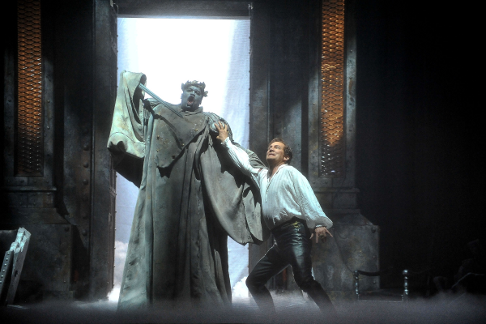
22  Mozart:  (Don Giovanni) A cenar teco m'invitasti    This song from Don Giovanni is entitled “You invited me to dinner.”  Don Giovanni is a nobleman who makes a habit of seducing young women and then throwing them out.  One time he invites the father of one of these girls to dinner, but when the old man discovers that the Don has pretended to be his daughter’s fiancĂ©e and spent the night with her, he challenges the Don to a duel, and gets killed by Don Giovanni.  Then his ghost, animating a stone Statue, turns up at the Don’s castle, saying that the Don had invited him to dinner.  The Don is scared stiff, and eventually is hounded into hell by the stone Statue.  In the song you can hear the Statue announcing its arrival, and Don Giovanni stammering a reply, and the Don’s faithful servant Leporello muttering fearfully to himself.  [Colin Davis, Covent Garden]

Monday, October 20, 2014

Apologies: WXPI was off the air

The station engineers are tinkering with the transmitter, and the station has been off the air for close to a week.

I'm going to leave Saturday's show on the system for next weekend; there's no point putting something new on if the one in the queue hasn't aired!

General News
Omissions.  As you can see, some notable items are missing from the shows; for instance, there are tons of duets that you might have been looking for, but did not hear on that show.  I recently discovered an entire disc of duets by Angela Gheorghiu and Roberto Alagna.  There is an article about the lovely opera star, talking about her breakup with Mr Alagna, which you might be interested in.  I don't listen to a lot of Italian opera, so I will find it difficult to select a duet or two to play on the program.  The pop duets available are numerous, and I will try and find some for you on another show!

Overtures, too, are numerous; classical music fans all have their favorites, and might not find all of them on next Saturday's show!  The same with the Variations; the Enigma Variations were conspicuous by their absence.  I will try to squeeze them in.  Also, I want to present a set of variations of the sort: What if Mozart wrote "Have yourself a Merry Little Christmas"?  I don't know where to look for those sorts of things!!

Running a Radio Station.  All I really know is how my particular show is run!

There is a computer in the station, with an enormous hard disc, and a clock-driven program that runs continuously.  Like an alarm you might have running on your own computer or on your smart phone, the station program is designed to play music from a particular folder at a particular time.  That's mainly it.

At particular times, too: roughly every 30 minutes, according to FCC (radio) rules, the program is instructed to play a station identification, which sits in a particular folder.  At these times, brief service messages (Public Service Announcements, or PSA's) are played, to take up a total of two minutes, for announcements and identification.  The messages played on the hour are a little more formal than those played at the half-hour.

For some programs, the show host sits right in the studio at the microphone, and plays music he has got ready as MP3s, or conducts an interview, or anything he likes.  These are live shows.  In these sorts of cases, the show host is in charge of the mid-hour interruptions.

For other programs, the show host sends in (by mail, by Internet, or by actually coming into the studio and uploading it) two 28-minute MP3s.  That leaves 2 minutes for the station messages at the half-hour and the hour.  This is called a Podcast, and they tried to get me to do this.  Unfortunately, when this plays over a car radio, for instance, no information is displayed except the name of the program.

For yet other programs, like ours, all the music files are loaded into the computer, with a playlist, which is just a text file with the music files listed carefully in order.  When the Station program plays this playlist, your car radios (and some home stereos) have the ability to display: the Title, the Performer, the Album, and some other information.  I like that, because I don't always announce the performer, but I make sure that the performer is listed on this extra information, which is called metadata.  If I tire of providing all that, I can go into a podcast format, where the extra information is not broadcasted.  I have to organize the playlist so that the music playtime adds up to four groups of 28 minutes (plus a couple of seconds, possibly), so that the program can splice in the station messages every half hour.

Finally, if there are slots where local programming is not available, the Station program is instructed to splice in a program from somewhere else.  These are called syndicated programs, which are selected by a sort of committee at our radio station.  We only air syndicated shows that are free; commercial stations have to pay for their syndicated shows, and NPR stations have to pay for their shows as well.

The broadcast stream.  The signal from the station goes via a trunk Internet line to a computer sitting at the foot of the transmitting tower, where it sends the signal (and a power cable) up the tower to the transmitter.  Ours is a tiny 1 Kilowatt transmitter, which only transmits at about 50% capacity, because it is old, and the connections are corroded, and there is a lot of power loss.  The station is in a constant battle to get a more powerful transmitter, and a higher location.  It so happens that a commercial station in Martha's Vineyard has just upgraded to a more modern transmitter, and we're trying to get their older transmitter for ourselves.  But we can't afford the extra juice it will need, and we don't have the resources to lug the transmitter here from Massachusetts!!!  Everybody at our station is a volunteer, though some of them would dearly like to be paid a stipend.

We have an agreement with TuneIn Radio to carry our broadcasts live on the Internet.  If you click on this link right away, you're going to get an error message because we're off the air.  Within a day or two, however, clicking on the link above at 8:00 p.m. on a Saturday should get you our show live.

Ideas for Future Shows
Obviously, I have to keep a list of potential themes for future shows.
Children's Music.
Early Music.  This is music from before Baroque times, and even early Baroque.
Unusual Instruments, and Early Instruments.
Unusual performances of well-known music.  I do some of this already, but there's a lot more available.  Computer performance is a major subclass.
Opera.  We've heard a certain amount of opera, but a few snippets could be interesting.
Modern Music.  I'm going to be very selective here, and only feature very mainstream music from the 20th century and later.
Music with stories associated with it.
Modern Suites.  For instance, the Mother Goose suite of Modest Mussorgsky, and Pictures at an Exhibition.
World Music.  There are other programs on our station that are based on this theme, but it's a big world.
Folk Music.
New Age takes on classical music, in other words, fusion music, and crossover music.
[Added later:]
Sonatas for various instruments.
Death, suffering and Grieving.  I don't know about this; young listeners are often hostile to this sort of thing.  But a lot of music was written in troubled times, and it is useful to be familiar with works that are concerned with suffering, death and anguish, so that when you're in that mood, you know where to go.
Choral music.  Writing good choral music is very hard, and when you hear good choral music, it is amazing.  It might be an acquired taste, and if you've sung in a choir, you're halfway there.
Marches.  This is a more popular genre than anyone would think, ranging from military marches to songs and tunes that just happen to be written as marches.
Music for plucked string: guitars, banjos, mandolins, lutes, and harps.  And, of course, harpsichords.
Symphonies.  These are just large-scale works according to a certain pattern, or form.  We've already listened to a number of them.  The 19th and 20th centuries had a surfeit of them, but some of them are excellent, and worth getting familiar with.  Obviously I don't know all the good ones, but I'm happy to share the few that I do know.
Halloween!!  I'm going to try and get together a nice mix of music, but scary music is not very common at all, unfortunately.  Luckily for all of us, another theme in Halloween is humor and comedy, and that might be helpful.


If you have ideas, tell me about them!

Archie.